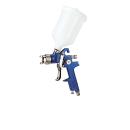
HVLP1.3

Hvlp paint gun
1.3mm Nozzle

Two cars of the same model, both ‘red’, and yet two different shades: it all comes down to the colour code and its variant.
The colour code is the exact identification of a vehicle’s shade. But behind this short code lie very different systems depending on the manufacturer, not to mention production variants and types of finish, which make all the difference during preparation of the paint. This guide, written from the perspective of the Carross workshop, sorts through the main families of colour codes to help you order the right shade first time round.
The one that changes everything: the trap of Ford colour codes
At Ford, the door label often displays a very short code (one or two characters, such as ‘J’ or ‘6K’). Beware of the trap: the manufacturer regularly reuses these codes! For example, the same character might refer to a Blue in 2012 and a Red in 2019.
This small factory code alone is therefore not enough for the preparation of your paint. To find the right colour, it must be cross-referenced with the exact model and year of the vehicle.
In fact, Ford has very precise internal codes (the XSC codes), but these are almost never shown on the label. Therefore, to keep things simple and ensure you order the correct part, contact your dealer with your chassis number (VIN): they will provide you with your exact colour code in a matter of seconds.
The colour code precisely identifies a vehicle’s factory colour. Its format varies depending on the manufacturer: numbers, letters, or a combination of both. A single code may correspond to several colour variants, and the type of finish (solid, metallic, pearlescent, tri-coat) determines the number of topcoats to be applied. Identifying these three factors prevents colour mismatches — this is the triple-check process carried out by the Carross team before every paint order.
The colour code is the reference that the manufacturer assigns to each colour in its range. It does not describe a colour ‘by feel’ but a precise formula: an exact mix of base coats and pigments which, when applied according to a specific process, recreates the original colour. It is this code, and not simply the colour’s commercial name, that enables the vehicle’s paintwork to be faithfully reproduced.
This distinction is important, as the same marketing name (‘metallic grey’, ‘midnight blue’) may correspond to several different codes depending on the year, market or production plant. Conversely, two vehicles from different makes may have similar names for colours that are in fact very different. The colour code is definitive: it is the only reliable piece of information for ordering a [custom-mixed paint](/order-custom-mixed-paint).
This guide does not explain where to find this code on the vehicle: this topic has its own dedicated page, [finding the car colour code](/finding-car-colour-code). The code is usually found on a manufacturer’s label, which, depending on the make, is located on a door pillar, under the bonnet, in the boot or in the engine compartment. It may also be listed in the service booklet, or even only in its digital version, which can sometimes make it harder to find. Although the colour code cannot be deduced directly from the number plate, certain software programmes and professional services now make it possible to find a paint code using the registration number or chassis number. However, the results depend on the data available for the vehicle. Once this code has been identified, you still need to work out which colour family it belongs to.
Each car manufacturer uses its own coding system. Knowing how to identify the exact format used by your make prevents ordering errors and ensures your paint is formulated correctly.
1. European manufacturers
Stellantis Group / formerly PSA (Peugeot, Citroën, DS, recent Opel models): The code consists of three letters, found on the tyre pressure label on the driver’s door pillar. Real-life examples: EWP (Banquise White), KTH (Thorium Grey), KTV / EXY (Perla Nera Black), LQV (Vertigo Blue).
Renault Group (Renault, Dacia, Alpine): The colour code consists of three alphanumeric characters, often preceded on the oval plate by a prefix indicating the finish (TE = Effect Colour / Metallic, OV = Opaque Clearcoat, NV = Pearlescent Clearcoat). Real-world examples: OV369 (Glacier White – base 369), TED69 (Platinum Grey), TENNP (Flame Red), TEGNE (Starry Black).
Volkswagen Group (VW, Audi, Seat, Škoda, Cupra): The format usually consists of 4 characters, most often beginning with the letter L. The label is located in the boot (near the spare wheel) or in the service booklet. Real-life examples: LC9A (Pure White), LC9X (Deep Black Pearl), LB9A (Candy White), LZ9Y (Audi Phantom Black Pearl).
BMW & MINI: A short 3-character code (numbers or letters/numbers), often accompanied by the official name of the colour in German or English on the label. Real-life examples: 300 (Alpinweiss III), 475 (Black Sapphire), C31 (Portimao Blue), A96 (Mineralweiss).
Mercedes-Benz: A standard 3-digit numerical code (which may include an internal prefix) located on the door pillar or under the bonnet. Real-life examples: 149 (Polar White), 197 (Obsidian Black), 775 (Iridium Grey), 992 (Selenite Grey).
2. Asian manufacturers
Toyota & Lexus: Short, 3-character alphanumeric codes. Real-life examples: 040 (Pure White / Super White II), 1F7 (Silver Metallic Grey), 209 (Black Sand Pearl), 070 (Blizzard Pearl / Pearl White).
Honda: 4 to 6-character codes, generally structured with a colour prefix and a final letter specifying the finish (P = Pearl, M = Metallic): Real-world examples: NH731P (Crystal Black Pearl), NH700M (Alabaster Silver Metallic), B588P (Obsidian Blue Pearl).
Nissan: Standard 3-character alphanumeric format: Real-life examples: KH3 (Super Black), QM1 (Cloud White), QAB (White Pearl).
Hyundai & Kia: Short 2- or 3-character codes: Real-world examples: SWP (Snow White Pearl), UD (Clear White), ABP (Aurora Black Pearl).
3. American manufacturers
American brands frequently distinguish between the commercial option code and the factory formulation code:
Ford: The code on the door label consists of 2 characters (e.g. YZ for Oxford White, J7 for Magnetic Grey), which corresponds in bodywork software to an extended factory code (e.g. M7089A). General Motors (Chevrolet, GMC, Corvette, Cadillac): Searches are based either on a 2- or 3-character code (e.g. 41U, GBA) or on the factory formula code beginning with WA (e.g. WA8555 for Black, WA8624 for Summit White).
Stellantis US (Jeep, Dodge, Chrysler, RAM): 3-character codes (e.g. PW7 for Bright White, PX8 for Pitch Black).
Tesla: The code always consists of 4 alphanumeric characters (very often beginning with the letter P for Paint). It is printed on the compliance label located on the centre pillar of the driver’s door (B-pillar), preceded by the words ‘PNT: ’ (or can be viewed directly on the touchscreen in the Software / Vehicle Information menu). Real-life examples: PPSW (Pearl White Multi-Coat), PBSB (Solid Black), PMNG (Midnight Silver Metallic), PPSB (Deep Blue Metallic), PR01 (Ultra Red), PN00 (Quicksilver), PN01 (Stealth Grey).
Golden rule for ordering paint: Never rely solely on the vehicle’s commercial name (the same commercial name, such as ‘Quartz Grey’ or ‘Polar White’, may correspond to completely different chemical formulations depending on the model year). Only the code shown on the vehicle’s identification plate guarantees the correct base formula.
This is the most common pitfall. The same colour code can correspond to several genuinely different formulations, known as variants. These discrepancies arise during production: different factories, years of manufacture, different paint suppliers, or simply variations in the production process over time. Two vehicles with exactly the same code may therefore have a slightly different shade.
For the body repair technician, ignoring these variants leads straight to a poor colour match: the colour prepared ‘to the code’ does not match the car exactly, and the difference is glaringly obvious on the panel. This is why the preparation of a colour is never limited to simply entering a code: it relies on colour charts, variant references and, ideally, a visual inspection of the vehicle.
In practical terms, when several variants exist for a single code, the one that best matches the vehicle’s actual colour is chosen, by comparing it on a clean area and under suitable lighting. This variant selection stage is crucial, especially for metallic and pearlescent colours, where the eye detects even the slightest discrepancy.
Beyond the colour code, each shade belongs to a finish category that determines its chemical structure, the number of layers and the application method. This is essential information for ordering the correct products and adapting your spray gun technique.
1. Opaque (or solid) colours
Structure: Pure opaque pigments, without effect particles (aluminium or pearlescent).
Process: Modern standard system (two-coat): A matt, opaque basecoat (water-based or solvent basecoat) followed by a clear 2K clearcoat to provide gloss and UV protection. Direct Gloss System (2K): The paint and hardener create the gloss in a single step (widely used on commercial vehicles and classic cars).
2. Metallic colours
Structure: A matt basecoat incorporating aluminium flakes of calibrated sizes and shapes (lenticular or irregular).
Process: Application is carried out in even layers, which must be followed by a positioning coat to orient the aluminium flakes uniformly.
Technical constraint: Uneven application causes a marbling effect (light and dark patches). The base must then be covered with a clear clearcoat.
3. Pearlescent shades (two-coat)
Structure: A matt basecoat containing synthetic mineral pigments (mica, borosilicate or Xirallic pigments) coated with light-refracting metal oxides.
Process: Similar to metallic finishes (matt basecoat + clearcoat), but the reflection varies in intensity and shade depending on the viewing angle.
Technical constraint: The thickness of the base film must be perfectly uniform to avoid variations in iridescence.
4. Three-layer colours
Structure: A system divided into three distinct successive stages.
Process: Layer 1 (Base coat): An opaque, matt basecoat that provides the background colour and seals the substrate/primer. Layer 2 (Effect base / Intermediate pearlescent layer): A semi-transparent layer containing pure pearlescent pigments. Layer 3 (2K clearcoat): Protection and final gloss.
Technical constraint: The number of coats applied in the intermediate layer directly affects the final colour (the more pearlescent coats applied, the more the colour yellows or darkens). It is essential to produce a test panel with multiple coats (1, 2 and 3 layers) before spraying the vehicle.
5. Colours with tinted clearcoat (OEM Candy / Translucent colours)
Structure: A colour where the deep hue is not only provided by the base coat, but by the clearcoat itself, which contains transparent pigments or dyes (candy effect colour).
Process: Basecoat (Layer 1): An opaque or highly reflective metallic base (often loaded with shiny aluminium flakes to create a mirror effect). Tinted clearcoat (Layer 2): 2K clearcoat mixed with a translucent colour concentrate. Light passes through this red or blue clearcoat, reflects off the underlying aluminium base and emerges with extreme brilliance and saturation. Pure clearcoat (Layer 3 – essential): A final layer of pure, colourless clearcoat is applied to protect the pigments in the tinted clearcoat from UV rays and to allow for subsequent buffing/polishing without altering the colour.
Technical requirements for bodywork: These are the most complex colours to apply, hence the need to produce a test cardboard. The thickness of the tinted clearcoat directly determines the final shade: a clearcoat that is too thick will result in a shade that is too dark, whilst one that is too thin will result in a shade that is too light. Blended edges require perfect control over the transitions.
Once the code has been identified, the variant chosen and the type of finish determined, all that remains is to translate this into paint that is actually ready for use. This is where colour matching comes in: using the formula corresponding to the code and its variant, we prepare the quantity of paint required for the job.
There are two supply approaches. [Bespoke colour-matched paint](/commander-peinture-a-la-teinte) exactly replicates the vehicle’s colour code and variant: this is the reliable method for an invisible colour match, which is essential for metallic, pearlescent and three-coat finishes. Conversely, standard bodywork paint may be suitable for simple colours or less visible parts, but it will not match the precision of a colour-matched paint preparation on a complex colour.
At Carross, the right approach is simple: the more technically complex the finish (metallic, pearlescent, three-coat) and the more visible the surface, the more important it is to use paint prepared exactly to the code and variant, checked against a colour chart before application.
- Opaque colour, inconspicuous component | standard bodywork paint possible - Metallic or pearlescent colour | colour-matched paint, variant check - Three-coat colour | colour-matched paint + test swatch to match the layers - Multiple variants for a single code | compare on the vehicle before mixing - Matching on a visible panel | always opt for preparation-matched paint - Code illegible or missing | identify via manufacturer and year before ordering - Carross colour matching | check code, variant and finish type before ordering; never rely on just one of the three
On a manufacturer’s label affixed to the vehicle: on the driver’s door pillar, under the bonnet, in the boot or in the engine compartment, depending on the make. The location varies from one manufacturer to another; full details are covered on our dedicated page [finding your car’s colour code](/finding-car-colour-code).
If the label is worn away or missing, you can trace the code back via the manufacturer, the exact model and model year, or possibly using the vehicle identification number (VIN) with the manufacturer. A professional can also identify the colour family using a spectrophotometer or a colour chart, and then verify it on a colour swatch.
The number plate alone does not provide the colour code: contrary to popular belief, no colour code is encoded on it. At best, the registration number can help you locate the vehicle and its VIN, but it is the manufacturer’s label or the vehicle specification sheet that provides the exact colour code. The registration number may enable you to find the colour code in certain specialised databases, but it does not allow you to deduce it directly.
First, note down the code from the manufacturer’s label, then check whether there are several variants for that code and identify the type of finish (solid, metallic, pearlescent, three-coat). Combining these three pieces of information allows you to prepare paint that matches the colour exactly and avoid any colour mismatch when touching up.
Updated: 07/07/2026
Check out our bodywork guides and tutorials. The Carross Tech’Team: +33 (0)1 60 27 20 19.