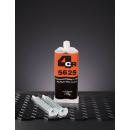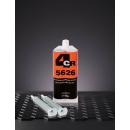
5626.0050

2K PU PVC adhesive
50ml - 3.5 minutes

Hard plastics used in the automotive industry, such as bumpers, grilles, panels or structural parts, require a specific adhesive to ensure a strong, durable repair. A powerful adhesive for hard plastics makes it possible to :
Repair broken or cracked plastics,
Assemble rigid bodywork components,
seal and strengthen parts exposed to mechanical and thermal stress.
This comprehensive guide explains:
Which plastics can be bonded,
How to choose the most suitable adhesive,
How to apply the adhesive for a long-lasting bond,
Professional advice on maximising adhesion,
Where to buy powerful glue for hard plastics.
Rigid automotive plastics (ABS, PVC, PP, PE, semi-rigid PU) are tough but difficult to assemble without a suitable adhesive. Conventional glue or household glue does not offer :
sufficient adhesion to hard plastics,
resistance to vibration and shock
lasting strength over time.
A powerful adhesive for hard plastics is formulated to :
Lightly penetrate the surface for better adhesion,
resist traction, shearing and impact,
withstand heat cycles, humidity and external stresses.
Plastic glue is used as a repair glue to join two bodywork parts together. These include bumpers and other parts such as mudguards, which can be bonded immediately with 2k adhesive. On the other hand, this glue is not called "super glue" because its properties are far more powerful than those of commercial glue.
This extra-strong plastic glue is your best ally if you want :
- guaranteed clean results
- a lifetime of resistance, even to shocks
A strong adhesive for hard plastics is very versatile:
Material | Suitable glue |
|---|---|
ABS / Rigid PVC | Two-component adhesive, MS polymer, PVC 2K PU |
PP / PE (difficult plastics) | Adhesive + primer |
Semi-rigid PU | MS polymer or two-component |
Pro tip: Even the best adhesive requires rigorous surface preparation (cleaning, degreasing, light sanding).
2k adhesive enables fast bonding, in just 90 seconds or 240 seconds depending on the drying time chosen. This special glue for rigid plastics will join the two parts together without drips or burrs, providing a solid anchorage.
The choice depends on several criteria:
Type of plastic: some rigid plastics require a high-performance adhesive (PVC 2K PU or two-component).
Use and bonding area: interior or exterior, structural or decorative parts.
Curing time: some two-component adhesives cure quickly, others take several hours to fully cure.
Mechanical resistance: check shear, tensile and impact strength.
2K PU PVC adhesive: fast setting, optimum adhesion to rigid plastics and compatibility with metal and ceramics.
MS polymer adhesive: flexible, waterproof, suitable for outdoor use and vibration.
Two-component epoxy adhesive: maximum mechanical resistance for structural parts.
For fast, instant bonding, you need to follow a few basic bodywork steps. The first step is to prepare the surface so that the strong adhesive can be applied without snagging, but here's how it works in detail:
Correct application is essential for effective bonding:
Preparing the surface
Clean the parts with rubbing alcohol or soapy water and leave to dry. Dirt, grease and dust prevent the adhesive from adhering properly. The smoother and cleaner the surface, the stronger the bond.
Lightly sand the surface
Two Part Structural Adhesives means respecting a Mixing ratio so that the adhesive can set. Use fine sandpaper (240-400 grit) to roughen the surface slightly. A micro-rounded surface increases the contact area and allows the glue to 'bite' the plastic.
Apply evenly to the area to be joined using a suitable gun, Nozzle or applicator.
For a strong, durable bond:
Spread the adhesive evenly over the entire area to be joined.
Use a suitable gun, mixing nozzle or applicator to control the flow and avoid excess.
Squeeze the trigger at a steady, even pace to force the prepolymer and Hardener through the mixer tip. It is advisable to discard the first
25 to 50 mm of product dispensed, as the ratio may be incorrect)
Avoid "shielded" areas or air holes which may affect adhesion.
Keep the parts under pressure after application to ensure that the adhesive penetrates and hardens properly.
Assemble the parts and hold under pressure for the initial setting time.
Allow to cure completely before handling.
Warning: Always work in a ventilated area, wear gloves and follow the manufacturer's instructions.
Make sure the surface is clean and dry, free from dust and grease.
Lightly sand hard plastics to create a mechanical bond.
Avoid overloading with adhesive, apply evenly.
For structural repairs, keep parts under pressure while curing.
Tip: a powerful adhesive for hard plastics can be used on plastics, fibre or ceramics, but surface preparation remains essential.
To ensure an effective repair, it's essential to buy a professional adhesive.
Specialist suppliers: guarantee quality and performance.
Online availability: products in stock, easy to add to basket.
Professional references: PVC 2K PU, MS polymer, two-component.
For this, you need to turn to the Carross range of PVC 2k PU adhesives. Carross offers the best glue online for bodywork professionals.
PVC 2K PU 4CR - 50 ml - 90 seconds is a benchmark for hard plastics, with maximum adhesion, fast curing and multi-material compatibility.
A powerful adhesive for hard plastics offers:
High shear and tensile strength, even on stressed parts.
Shock and vibration resistance, ideal for bodywork.
Durability over time, even outdoors or in damp conditions.
Tip: final strength depends as much on the product as on preparation and application.
Powerful adhesive for hard plastics is essential for repairing and assembling rigid automotive plastics reliably and durably.
By choosing a professional adhesive (two-component, PVC 2K PU or MS polymer) and following good preparation and application practices, you can guarantee a solid repair that is resistant to mechanical stress and the elements.